


Romney’s Tax Plan Is Class Warfare, Not Serious Reform
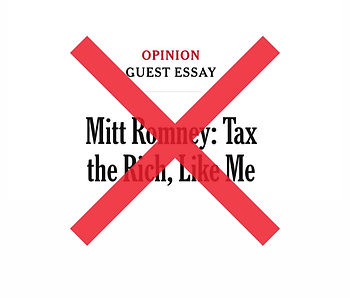
Conservatives were right to be skeptical of Mitt Romney. His latest tax proposals confirm why.
In a recent New York Times op-ed, Romney argues for a new round of “tax the rich” policies. They are sold as deficit reduction. In reality, they raise little revenue, hammer economic growth, and rely on class warfare talking points instead of serious reform. The proposals read more like bumper-sticker economics than a workable tax plan.
Sky-High Marginal Tax Rates on Work
Romney’s first major proposal is to apply the payroll tax to high earners. That sounds modest until the math is done.
Applying the FICA tax at the top would push the federal marginal tax rate on labor income from about 40.8 percent to roughly 53.2 percent, before state taxes are even counted. That would be the highest marginal rate on work since 1971, more than half a century ago.
This is not a technical tweak. It is a recession-inducing tax hike that directly penalizes work, entrepreneurship, and productivity.
Making the Death Tax Even Worse
Romney also proposes taxing unrealized capital gains at death, on top of the existing estate tax.
During his 2012 presidential campaign, Romney ran on repealing the death tax. Now he wants to stack a second tax on the same assets. Sound tax policy is to tax income once. Either tax capital gains at death or impose an estate tax. Doing both is double taxation by design.
Romney knows this, or should.
Killing 1031 Exchanges for Little Gain
Another proposal would eliminate Section 1031 like-kind exchanges for real estate. These exchanges allow investors to roll gains into a new property rather than pay capital gains taxes every time they sell.
Ending 1031 exchanges would force tax payments on every transaction, slowing real estate markets and discouraging reinvestment. Yet even the federal scorekeepers admit the revenue impact is tiny. The Joint Committee on Taxation estimates the change would raise only about $10 billion per year.
That is a lot of economic damage for very little deficit reduction.
More Small-Ball, Anti-Growth Tax Hikes
Romney rounds out the package with other familiar ideas. He would tax carried interest as ordinary income and tinker further with estates and charitable giving. Again, the theme is clear. These policies raise little money but send a loud political signal.
This is more about class warfare than fiscal responsibility.
The Bigger Picture
Taken together, these proposals explain why many conservatives never trusted Romney. This is not a growth agenda. It is a grab bag of tax hikes aimed at high earners that would slow the economy while barely moving the fiscal needle.
There is little doubt that, given the chance, Romney would have sold out taxpayers in a so-called grand bargain, much like George H. W. Bush did in 1990.
Serious tax reform should broaden the base, lower rates, and promote growth. Romney’s plan does the opposite.


Comments