


New Trump Plan Would Give Private Workers Access to Federal Retirement System
- Feb 25
- 3 min read
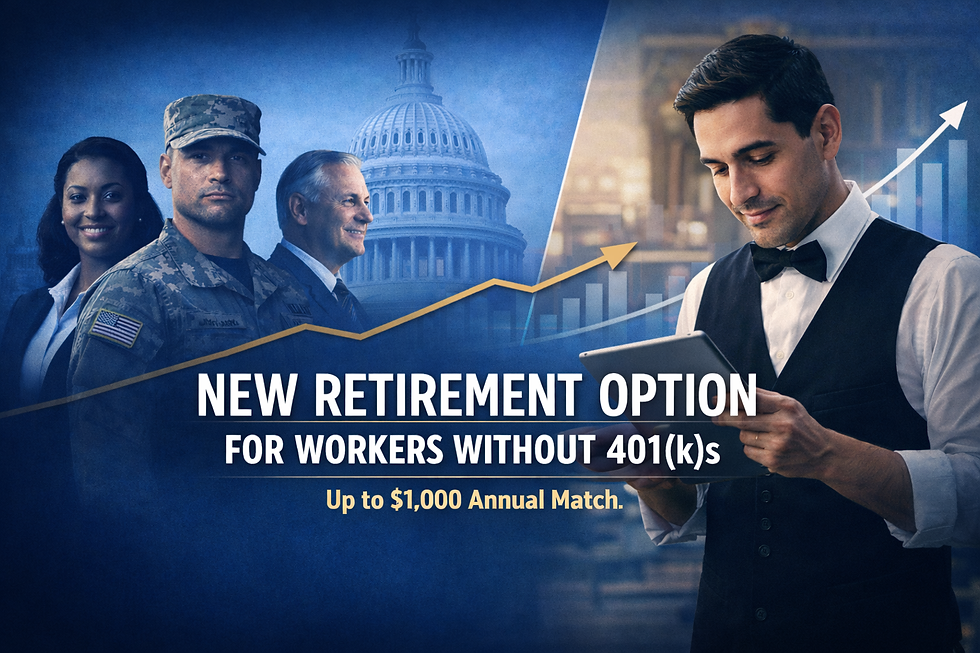
President Trump used his State of the Union address to make a clear commitment: protect Social Security and Medicare while expanding access to private retirement savings. He also announced a new initiative aimed at workers who lack access to employer-sponsored 401(k) plans.
The proposal would give these workers access to the same retirement plan used by nearly 2 million federal civilian employees, every Member of Congress, and members of the military. It would also include a government match of up to $1,000 per year. The goal is to close a major gap in the current system and allow more Americans to benefit from long-term market growth.
A Retirement Gap That Still Exists
The president noted that since taking office, the typical 401(k) balance has increased by at least $30,000, reflecting strong stock market performance and rising account values. Yet roughly half of working Americans still do not have access to a workplace retirement plan with matching employer contributions.
That disparity is significant. Workers with access to payroll-deduction retirement accounts and matching contributions are far more likely to accumulate meaningful savings. Workers without access often save little or nothing.
According to reporting from 401(k) Specialist Magazine, the administration’s proposal would allow workers without employer plans to participate in a federally administered retirement account modeled on the system currently available to federal employees and lawmakers.
Semafor has also reported that the White House is weighing key structural details, including how the plan would operate and how it would be funded.
Modeled on the Thrift Savings Plan
The concept appears to draw directly from the Thrift Savings Plan. The TSP recently surpassed $1 trillion in assets, underscoring both its scale and its record as a low-cost, diversified retirement platform.
The TSP’s growth reflects decades of steady contributions, disciplined investing, and broad participation. It is widely regarded as one of the most efficient defined-contribution systems in the country because of its low fees and streamlined investment options.
Extending access to that structure would give private-sector workers the same institutional advantages currently available to federal employees, elected officials, and service members.
A $1,000 Annual Match
Under the proposal described in the president’s address, eligible workers would receive a federal match of up to $1,000 per year on their contributions. The president framed the policy as a way to ensure that all Americans can participate in a rising stock market, not just those employed by firms that offer retirement benefits.
Important implementation details remain to be finalized. Eligibility thresholds, income limits, funding mechanisms, and interaction with existing retirement rules will determine the program’s ultimate reach and cost. But the core idea is straightforward: expand access and create an incentive for long-term saving among workers who are currently outside the system.
Retirement Security Requires Structural Reform
While the president pledged to protect Social Security and Medicare, preserving those programs in their current form will not be enough to secure them for future generations. Both programs face long-term financing shortfalls driven by demographic change, longer life expectancy, and rising health costs.
If Social Security and Medicare are to remain the safety net they have been for decades, structural entitlement reform is badly needed. Without reform, automatic benefit growth and looming trust fund depletion will eventually force abrupt benefit cuts or significant tax increases.
Expanding access to personal retirement savings is a constructive step. It promotes ownership, investment, and long-term wealth building. But true retirement security requires a balanced approach: strengthen private savings while modernizing the entitlement programs that serve as the foundation of the system.
A durable retirement framework must combine sustainable entitlement reform with broader participation in capital markets. Anything less risks undermining both the safety net and the long-term financial independence of future retirees.


Comments