


Federal Health Care Spending Is Driving Costs Higher

The federal government has steadily taken a larger role in American health care, and that expansion has helped drive a system in which health care spending grows faster than the economy. More federal spending and subsidies have put more money into the health care system while weakening the market pressures that would otherwise force providers and insurers to compete more aggressively on price.
In 1962, federal health programs accounted for just 7.2% of national health spending. By 2025, that share had climbed to 39.3%, according to a Tax Foundation analysis. Over the same broad period, health care grew from a relatively small part of the U.S. economy into one of its largest expenses.
The relationship is visible in the long-term spending data. World Health Organization figures show health expenditures rising from roughly 12% of U.S. GDP around 2000 to more than 16% in 2023, while CMS estimates put the figure at 18% in 2024. Americans are devoting an ever-larger share of the economy to health care even as Washington spends more to make it affordable.
Many factors contribute to rising health costs, including an aging population, medical advances and greater use of health services. But federal policy is part of the problem. Decades of expanding subsidies, government payment systems and regulation have reduced incentives to control underlying costs. Responding to that record with still more federal intervention would continue the approach that helped create the affordability problem in the first place.
Washington’s Role Has Expanded for Decades
The federal government was a relatively small player in health care before the creation of Medicare and Medicaid. That changed dramatically after 1965.
Medicare and Medicaid made Washington a major purchaser of health care, and subsequent expansions have increased that role. Federal taxpayers now finance Medicare, Medicaid, Obamacare subsidies and a range of other health programs and tax preferences.
The Tax Foundation data show how significant that shift has been. Federal health outlays rose from 7.2% of national health spending in 1962 to 39.3% in 2025. Federal health programs now account for nearly four out of every 10 dollars spent on health care.
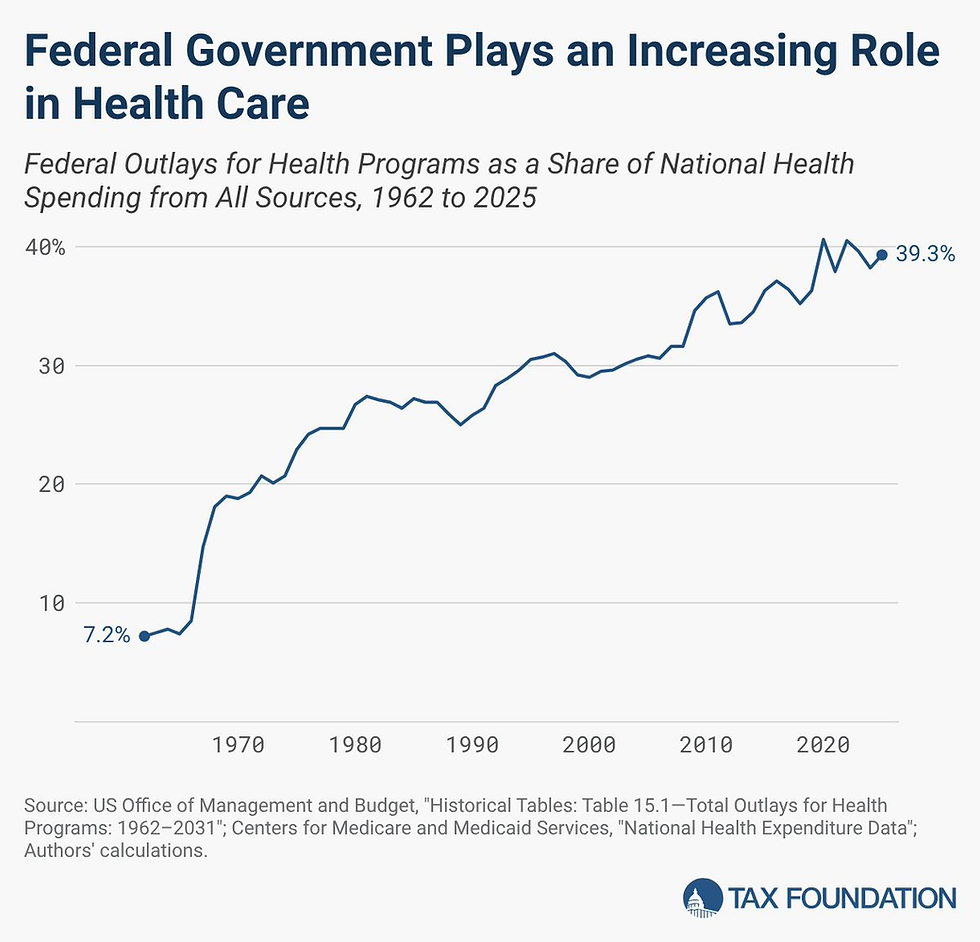
That much federal money flowing through the health care system affects how the market operates. When government programs or third parties pay a large portion of the cost, patients have less reason to compare prices and providers face less pressure to compete directly for their business. Federal subsidies can make an individual bill easier to pay without making the underlying health care service less expensive.
Health Care Keeps Taking More of the Economy
If greater federal involvement were successfully controlling health care costs, health spending should not be consuming an ever-larger share of the economy. Instead, the opposite has happened.

National health expenditures reached $5.3 trillion in 2024, according to the Centers for Medicare and Medicaid Services. That amounted to $15,474 for every person in the country and 18% of GDP.
The long-term trend is even more important. Health care spending has grown faster than the economy, meaning the increase cannot simply be explained by a larger population or a growing economy. More of the country's economic resources are being directed toward health care.
That pressure is expected to continue. CMS projects national health expenditures to grow by an average of 5.4% annually from 2025 through 2034, compared with 4.1% annual economic growth. If those projections hold, health care will consume 20.6% of GDP by 2034.
Subsidizing Costs Does Not Lower Them
Washington has often responded to rising health costs by spending more money to help someone else pay the bill. That can change who bears the immediate cost, but it does not necessarily make the underlying service less expensive.
This problem is especially pronounced in health care because consumers are already separated from prices by layers of government programs, insurers, employers and subsidies. Adding more federal money can further weaken the connection between the patient receiving a service and the price being charged for it.
Price controls create a different version of the same problem. Setting a government price can reduce what a federal program pays for a particular service or drug, but it does not create the competitive pressure needed to lower costs throughout the health care system.
A more sustainable approach would put greater pressure on providers and insurers to compete for patients. Greater price transparency, more consumer control over health care dollars and fewer federal policies that protect health care institutions from normal competition would begin moving the system in that direction.
CFE Takeaway
The federal government has gone from financing 7.2% of national health spending in 1962 to 39.3% in 2025. Over that period, health care has become an increasingly expensive part of the American economy.
Federal policy is not responsible for every increase in health spending, but decades of greater federal spending, subsidies and control have not delivered affordable health care. Washington should stop treating more government involvement as the solution to a problem it has helped create. Greater competition, consumer choice and market discipline offer a better path toward bringing health care costs under control.


Comments