


California Is Undermining Washington’s Push to Rebuild American Manufacturing
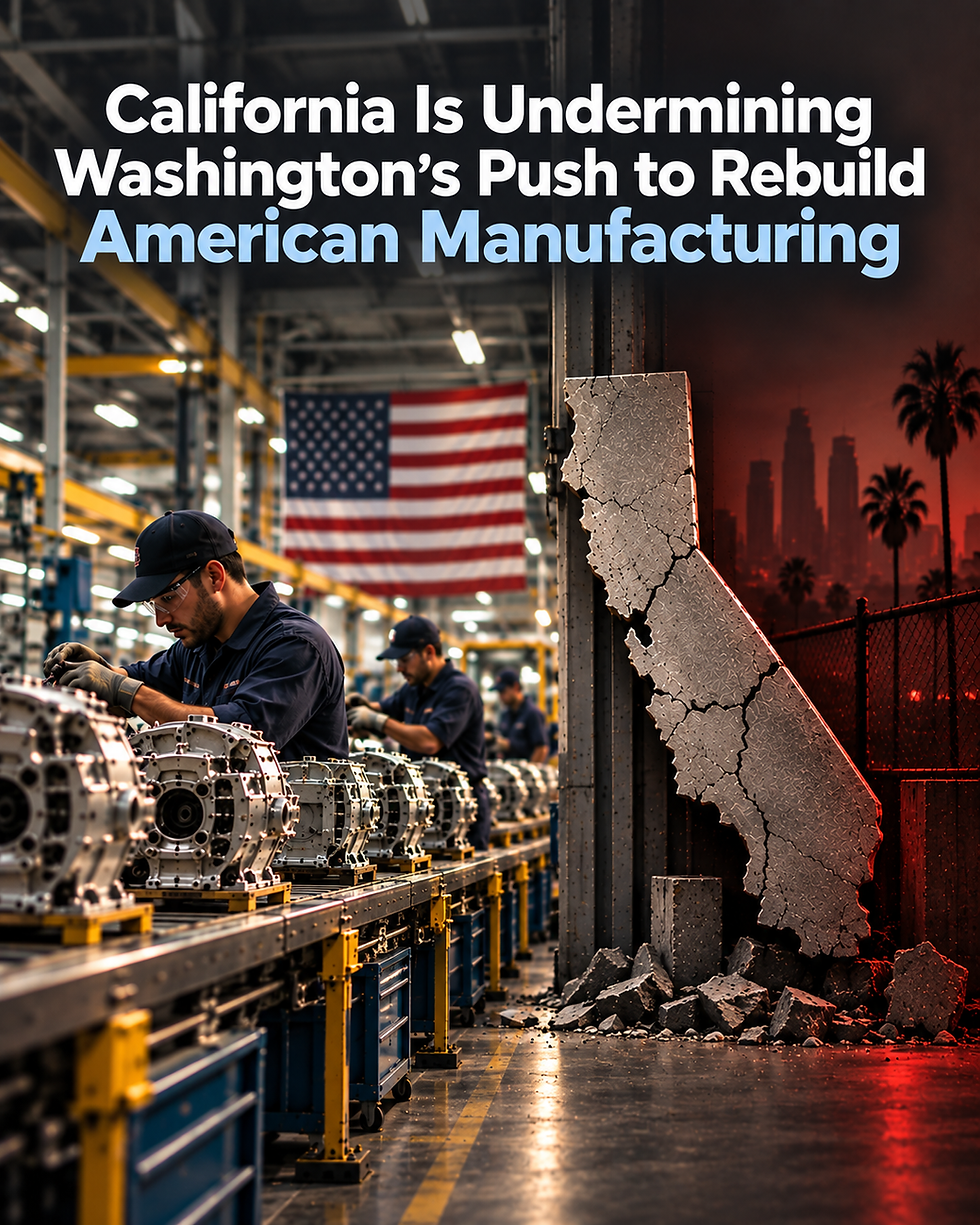
Washington has taken steps to encourage domestic investment, expand manufacturing, and prepare more Americans for skilled careers. California’s high costs are threatening to undermine that progress in one of the country’s most important manufacturing states.
The Working Families Tax Cuts improved the federal tax treatment of business investment, domestic research and development, and new production facilities. The law also expanded the use of 529 education savings plans for workforce credentialing and apprenticeship programs. These changes give businesses stronger incentives to invest and workers more options to acquire skills without pursuing a traditional four-year degree.
The challenge in California is increasingly whether workers can afford to live near the jobs these policies are intended to support.
Former U.S. Rep. Mike Garcia recently highlighted that problem in a Fox News op-ed focused on California’s defense industrial base. The state is home to more than 30 major defense installations and a large network of manufacturers, aerospace companies, technology firms, and suppliers. Those employers depend on engineers as well as welders, machinists, mechanics, technicians, and other skilled workers.
California should be well positioned to benefit from federal policies encouraging domestic manufacturing. Its affordability problems are making that more difficult.
Federal Tax Policy Is Encouraging New Investment
Manufacturing requires substantial upfront investment in facilities, machinery, research, and equipment. The Working Families Tax Cuts improved the federal tax treatment of those investments.
The law permanently restored full expensing for qualifying business investments and domestic research and development. It strengthened small business expensing and created temporary full expensing for qualifying production facilities.
For manufacturers, these provisions reduce the tax penalty associated with investing in new production. That is especially important for the defense industrial base, which relies not only on major contractors but also on smaller manufacturers and suppliers throughout the country.
Increasing American defense production will require these companies to expand facilities, purchase equipment, conduct research, and add capacity. Federal tax policy now provides stronger incentives to make those investments domestically.
More Options for Training Skilled Workers
Expanding manufacturing capacity requires a workforce capable of filling the jobs that come with it.
The Working Families Tax Cuts expanded 529 education savings plans to cover a broader range of qualified workforce and credentialing expenses. As CFE previously reported, families can use 529 funds for eligible costs associated with postsecondary credentialing programs, including certain certificates, testing expenses, and apprenticeships.
The change recognizes that valuable career training extends beyond a traditional college education.
That is particularly relevant to manufacturing. Welders, machinists, mechanics, technicians, and other skilled workers often enter their fields through apprenticeships, technical education, and professional credentialing. Expanding the eligible uses of 529 funds gives families another way to finance those career paths.
The federal government has improved both sides of the equation by encouraging businesses to invest while giving workers more options to train for the jobs those investments create.
California Is Eroding Its Competitive Advantage
California’s economic policies risk offsetting some of those federal gains.
Garcia notes that skilled trade positions connected to California’s defense industry can pay approximately $90,000 to $100,000 annually. Yet California’s high housing, energy, insurance, transportation, and tax costs reduce how far those salaries go.
That creates a significant problem for employers trying to recruit and retain skilled workers. A competitive salary becomes less competitive when workers can earn comparable wages elsewhere while facing substantially lower living costs.
California has already experienced sustained domestic out-migration. CFE previously examined the movement of taxpayers from high-tax states such as California to lower-tax states and California’s efforts to tax certain income received by former residents after they have moved elsewhere.
For manufacturers, the consequences extend beyond the loss of taxpayers. Defense and aerospace production depends on specialized workers who often take years to train and replace. If those workers leave, employers face higher recruitment costs and a smaller local labor pool.
Over time, workforce availability can influence where businesses choose to expand and where future investments are made.
California Should Build on Federal Progress
California begins with advantages that many states would like to have. It has major military installations, established aerospace and defense manufacturers, research institutions, experienced engineers, skilled trades, and an extensive supplier network.
Federal policy has created new opportunities to build on those advantages. Businesses have stronger incentives to invest in domestic production, while families have more options to finance the technical training needed for skilled careers.
California policy should reinforce those incentives rather than work against them.
Reducing the cost of living and improving the state’s competitiveness would make it easier for manufacturers to retain workers and capitalize on federal incentives for new investment. Continuing along the current path risks sending workers, businesses, and eventually investment to states where the economics are more favorable.
CFE Takeaway
The Working Families Tax Cuts strengthened incentives for domestic manufacturing, business investment, research, and workforce training. Those reforms can help expand the skilled workforce and productive capacity needed for a stronger American defense industrial base.
California should be one of the biggest beneficiaries. Instead, high living costs and an unfavorable economic environment are making it harder for employers to retain the skilled workers those investments require.
Washington has created better conditions for businesses to invest and workers to train. California policymakers should stop eroding those gains and make the state a more affordable and competitive place for the workers and manufacturers already there.


Comments